

Search is transforming faster than at any point in the last decade. For years, brands have invested heavily in SEO (Search Engine Optimization)—the science of ranking higher on Google and driving organic traffic.
But today, a new competitor has entered the arena: AI-generated answers.
Whether through Google’s AI Overviews, ChatGPT, Perplexity, or other generative search tools, users now receive instant answers before they ever click a link.
This shift has created a new discipline that marketers can no longer afford to overlook:
GEO – Generative Engine Optimization.
What Is GEO?
GEO is the practice of optimizing your content so AI systems can easily find, understand, and use it in their generated answers.
Instead of only competing for a position on a traditional search results page, brands must now compete for visibility inside AI-generated summaries—the content that users increasingly consume first.
If SEO determines how search engines rank your website,
GEO determines whether AI chooses your content at all.
Why GEO Matters Right Now
The rise of AI-driven search marks a major shift in user behavior:
🔍 1. Users are clicking fewer links
AI Overviews, ChatGPT, and other generative tools answer questions instantly. Users no longer need to browse multiple pages for simple queries.
⚙️ 2. Brands are losing visibility without realizing it
Even websites with strong SEO may not appear in AI-generated responses if their content isn’t structured for generative engines.
🧠 3. AI relies on trusted, structured sources
If your brand isn’t considered credible, authoritative, and easy to parse, AI simply won’t pull from your content—no matter how high your SEO ranking is.
🚀 4. GEO is becoming a key competitive advantage
Early adopters will dominate AI visibility the same way early SEO adopters dominated Google rankings years ago.
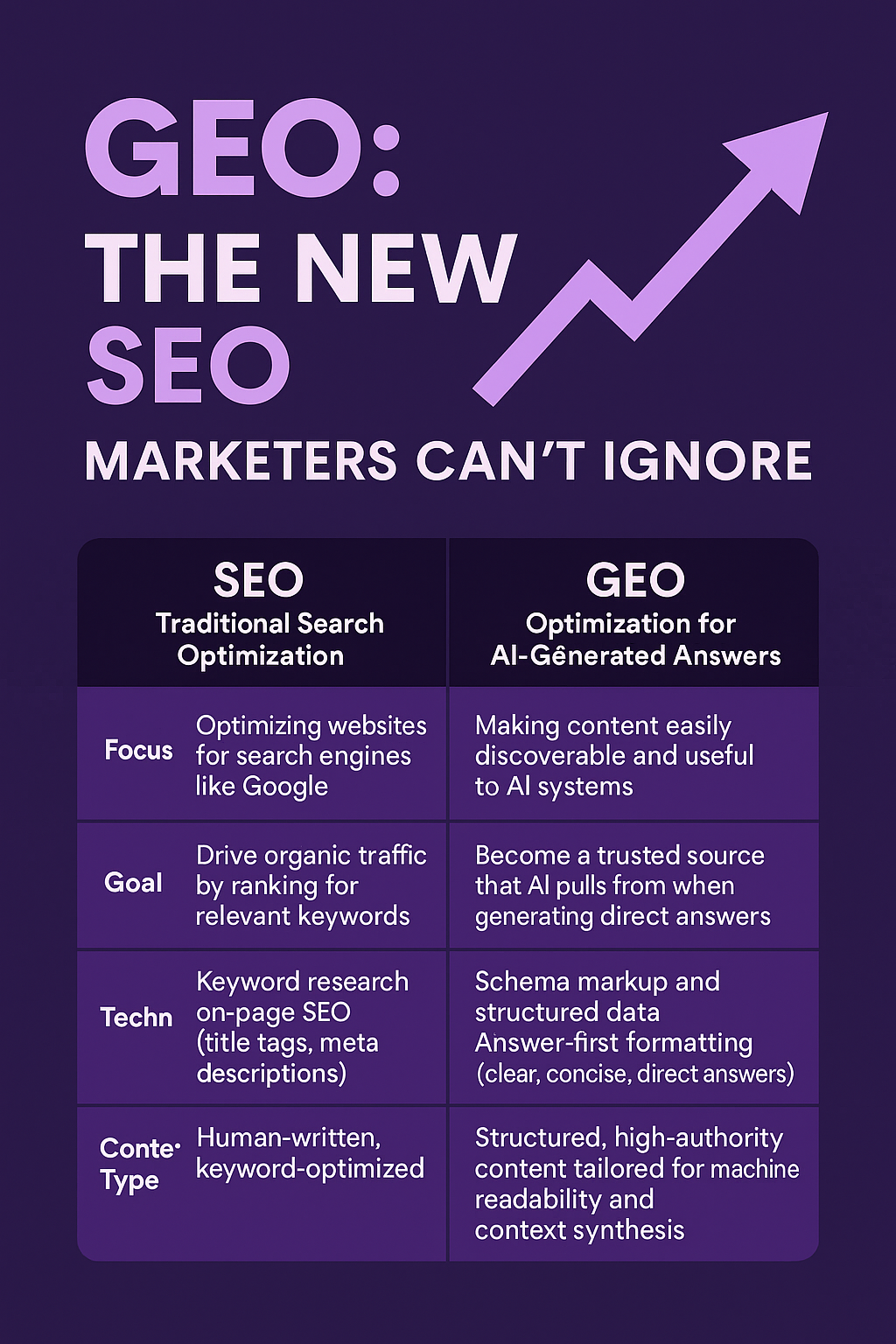
GEO vs SEO: What’s the Difference?
SEO focuses on:
- Ranking higher on Google and Bing
- Keyword searches
- Metadata and on-page structure
- Earning backlinks
- Improving website UX
GEO focuses on:
- Creating content formatted for AI consumption
- Using structured data and schema markup
- Providing direct, concise, answer-first responses
- Ensuring credibility and authority
- Writing content that is easy for AI models to summarize and cite
In reality, both are essential.
SEO brings traffic; GEO gets you selected as a “source” in AI’s answers.
How to Optimize for GEO
Here are practical steps brands should take to start building AI-ready content:
1. Use Answer-First Formatting
Write content like you’re responding to an AI prompt:
- Start with the clear, direct answer
- Then add context, detail, or examples
This makes your content more “AI-friendly.”
2. Add Structured Data (Schema Markup)
Schema helps AI:
- Identify what your page is about
- Break information into usable pieces
- Validate that the content is trustworthy
A must-have for GEO.
3. Strengthen Authoritativeness
AI looks for reputable, consistent sources.
Boost authority by:
- Publishing expert-written content
- Using citations
- Demonstrating credibility (awards, certifications, credentials)
4. Optimize for Natural-Language Queries
AI-driven search focuses on:
- Conversational questions
- Context-based queries
- “What is…” “How to…” “Why does…” prompts
Your content should mirror that structure.
5. Update and Refresh Content Frequently
AI models value:
- Recency
- Relevance
- Ongoing accuracy
Fresh content increases your chance of being included in AI summaries.
The Future of Search Is Hybrid
SEO alone is no longer enough.
But GEO doesn’t replace SEO – it works alongside it.
SEO = Visibility in traditional search results
GEO = Visibility in AI-generated answers
Brands that master both will dominate the next generation of organic discovery.
AI-driven search is reshaping how users consume content, and GEO represents the next major evolution in digital marketing.
Marketers who adapt now will be the ones who stay visible, competitive, and relevant.
If your brand wants to stay ahead—not behind—now is the time to update your strategy for the era of AI-powered search.
Interested in learning more –> Book your FREE discovery call with one of our specialists!


Leave A Comment